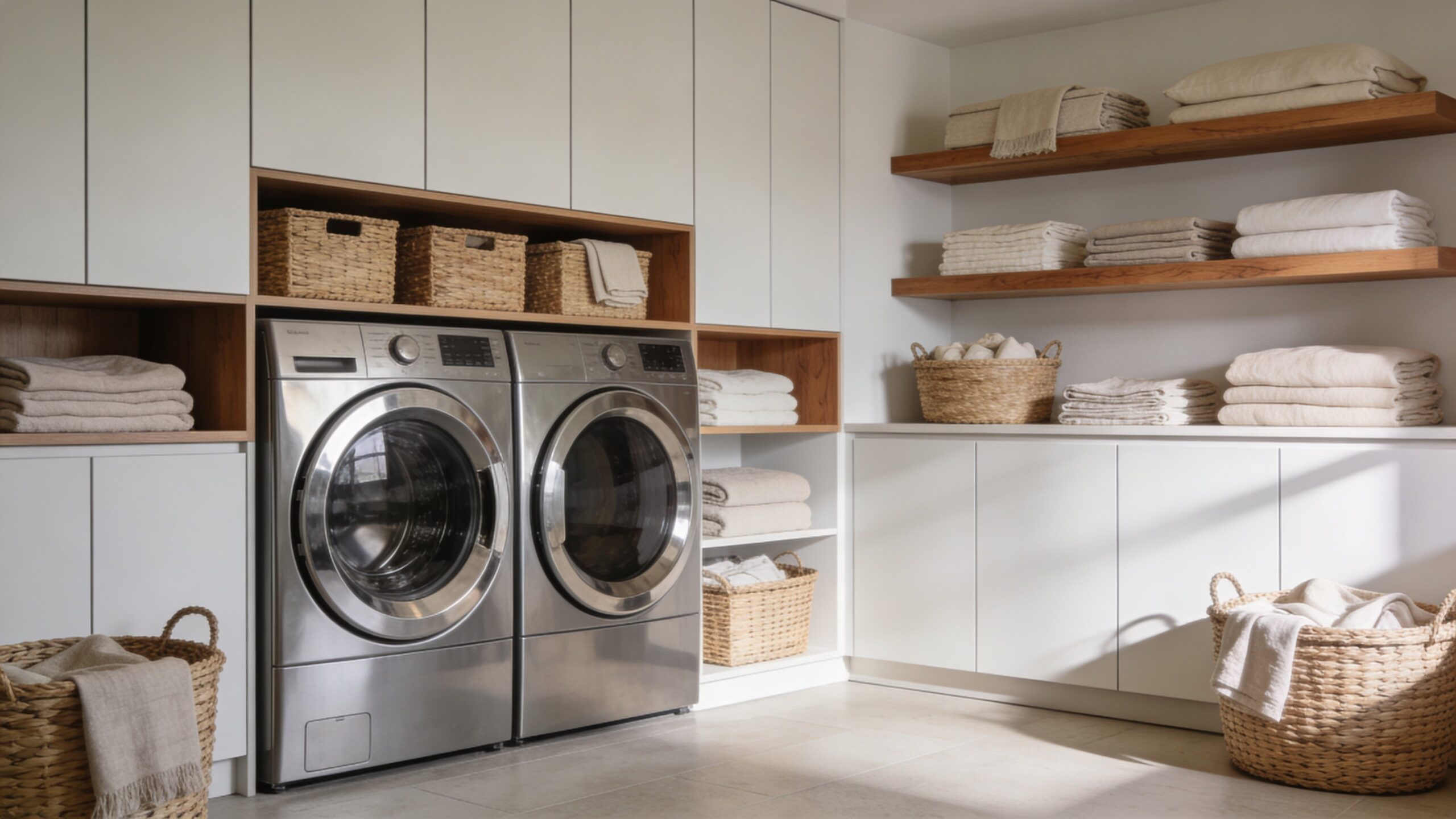
Laundry Room Organization Ideas for Busy Families Begins With the Daily Routine
Family laundry becomes manageable when organization follows ownership, timing, and next action instead of forcing every garment into an elaborate display system. The room needs clear handoffs that still work on rushed weekdays. The planning process should begin with verified equipment information, site conditions, and a walkthrough of one complete load. Consider who uses the room, how baskets arrive and leave, what requires special treatment, and which maintenance tasks must remain accessible. Modern design is most convincing when clear geometry supports those actions without turning useful capacity into display. Materials, colors, and hardware can then reinforce the plan instead of compensating for unresolved circulation or storage. This approach also protects the budget: money goes first to water management, ventilation, lighting, durable work surfaces, and ergonomic reach, followed by decorative choices that strengthen the room’s character. The result should remain understandable on a busy day, serviceable years later, and visually composed after ordinary objects return.
A: Count regular loads, peak-day loads, uniforms, bedding, towels, sports items, delicates, and recurring stain treatment before assigning cabinets or buying matching containers. Verify the decision against site conditions, product instructions, and the household's routine.
A: Use labeled-by-location logic, distinct basket positions, colors, or durable symbols chosen by the household so clean items can leave the room without being resorted repeatedly. Verify the decision against site conditions, product instructions, and the household's routine.
A: Protect distinct surfaces and containers for incoming garments and completed laundry, preventing clean stacks from sharing the same counter edge used for stains or damp items. Verify the decision against site conditions, product instructions, and the household's routine.
A: Place an easy receiving basket or sorter near the entry without narrowing circulation, blocking doors, or allowing loose clothing to spread across the floor. Verify the decision against site conditions, product instructions, and the household's routine.
A: Set age-appropriate hooks, basket openings, and simple categories within safe reach while keeping chemicals, sharp tools, and heavy supplies secured away from children. Verify the decision against site conditions, product instructions, and the household's routine.
A: Keep daily products close to the washer in original packaging, move bulk refills to stable lower storage, and separate incompatible substances according to manufacturer guidance. Verify the decision against site conditions, product instructions, and the household's routine.
A: Select containers by route, load weight, grip, ventilation, stair use, and storage footprint rather than appearance alone, then give every basket a parking location. Verify the decision against site conditions, product instructions, and the household's routine.
A: Reserve a visible priority position for items needed the next day so uniforms, workwear, and activity clothing do not disappear inside an ordinary mixed load. Verify the decision against site conditions, product instructions, and the household's routine.
A: Contain loose buttons, coins, stain notes, single socks, and simple mending tools in small assigned zones with a regular decision date instead of indefinite accumulation. Verify the decision against site conditions, product instructions, and the household's routine.
A: Provide enough rail length and hanger storage for actual air-dry volume without spanning an aisle, dripping over clean items, or blocking upper doors. Verify the decision against site conditions, product instructions, and the household's routine.
Organize Around the Household’s Real Laundry Volume
Count regular loads, peak-day loads, uniforms, bedding, towels, sports items, delicates, and recurring stain treatment before assigning cabinets or buying matching containers. Resolve this part of family organization planning before finishes are ordered, because dimensions and access decisions tend to affect several trades at once. Use confirmed product information and site measurements, then compare the proposal with the household’s ordinary laundry sequence rather than an empty-room photograph.
Test organize around the household’s real laundry volume with the heaviest basket, largest repeated load, and the people who use the room most often. Watch for unnecessary turns, overhead lifting, blocked doors, narrow standing positions, and surfaces that collect unrelated objects. A full-scale mockup or taped outline can expose these conflicts while changes are still inexpensive.
Coordinate this decision with cabinetry, lighting, flooring, utilities, ventilation, and appliance service. A detail can look independent on an elevation while creating a difficult repair or cleaning condition behind it. Record required clearances and identify every element that must remain removable, visible, or safely reachable.
Give Every Person a Clear Handoff
Test give every person a clear handoff with the heaviest basket, largest repeated load, and the people who use the room most often. Watch for unnecessary turns, overhead lifting, blocked doors, narrow standing positions, and surfaces that collect unrelated objects. A full-scale mockup or taped outline can expose these conflicts while changes are still inexpensive.
Separate Dirty Sorting From Clean Folding
Coordinate this decision with cabinetry, lighting, flooring, utilities, ventilation, and appliance service. A detail can look independent on an elevation while creating a difficult repair or cleaning condition behind it. Record required clearances and identify every element that must remain removable, visible, or safely reachable.
Review the choice again after equipment and storage are loaded. Listen for vibration, check shadows and reflections, operate doors together, and clean the area with the approved method. Correct small alignment or hardware problems before they become accepted friction in the routine, and keep the final specifications with household records.
Create a Low-Friction Drop Zone
Review the choice again after equipment and storage are loaded. Listen for vibration, check shadows and reflections, operate doors together, and clean the area with the approved method. Correct small alignment or hardware problems before they become accepted friction in the routine, and keep the final specifications with household records.
Place an easy receiving basket or sorter near the entry without narrowing circulation, blocking doors, or allowing loose clothing to spread across the floor. Resolve this part of family organization planning before finishes are ordered, because dimensions and access decisions tend to affect several trades at once. Use confirmed product information and site measurements, then compare the proposal with the household’s ordinary laundry sequence rather than an empty-room photograph.
Test create a low-friction drop zone with the heaviest basket, largest repeated load, and the people who use the room most often. Watch for unnecessary turns, overhead lifting, blocked doors, narrow standing positions, and surfaces that collect unrelated objects. A full-scale mockup or taped outline can expose these conflicts while changes are still inexpensive.
Build a System Children Can Actually Use
Set age-appropriate hooks, basket openings, and simple categories within safe reach while keeping chemicals, sharp tools, and heavy supplies secured away from children. Resolve this part of family organization planning before finishes are ordered, because dimensions and access decisions tend to affect several trades at once. Use confirmed product information and site measurements, then compare the proposal with the household’s ordinary laundry sequence rather than an empty-room photograph.
Test build a system children can actually use with the heaviest basket, largest repeated load, and the people who use the room most often. Watch for unnecessary turns, overhead lifting, blocked doors, narrow standing positions, and surfaces that collect unrelated objects. A full-scale mockup or taped outline can expose these conflicts while changes are still inexpensive.
Store Products by Frequency and Risk
Test store products by frequency and risk with the heaviest basket, largest repeated load, and the people who use the room most often. Watch for unnecessary turns, overhead lifting, blocked doors, narrow standing positions, and surfaces that collect unrelated objects. A full-scale mockup or taped outline can expose these conflicts while changes are still inexpensive.
Coordinate this decision with cabinetry, lighting, flooring, utilities, ventilation, and appliance service. A detail can look independent on an elevation while creating a difficult repair or cleaning condition behind it. Record required clearances and identify every element that must remain removable, visible, or safely reachable.
Review the choice again after equipment and storage are loaded. Listen for vibration, check shadows and reflections, operate doors together, and clean the area with the approved method. Correct small alignment or hardware problems before they become accepted friction in the routine, and keep the final specifications with household records.
Keep daily products close to the washer in original packaging, move bulk refills to stable lower storage, and separate incompatible substances according to manufacturer guidance. Resolve this part of family organization planning before finishes are ordered, because dimensions and access decisions tend to affect several trades at once. Use confirmed product information and site measurements, then compare the proposal with the household’s ordinary laundry sequence rather than an empty-room photograph.
Use Baskets as Moving Equipment
Coordinate this decision with cabinetry, lighting, flooring, utilities, ventilation, and appliance service. A detail can look independent on an elevation while creating a difficult repair or cleaning condition behind it. Record required clearances and identify every element that must remain removable, visible, or safely reachable.
Plan for Uniforms and Deadline Garments
Review the choice again after equipment and storage are loaded. Listen for vibration, check shadows and reflections, operate doors together, and clean the area with the approved method. Correct small alignment or hardware problems before they become accepted friction in the routine, and keep the final specifications with household records.
Reserve a visible priority position for items needed the next day so uniforms, workwear, and activity clothing do not disappear inside an ordinary mixed load. Resolve this part of family organization planning before finishes are ordered, because dimensions and access decisions tend to affect several trades at once. Use confirmed product information and site measurements, then compare the proposal with the household’s ordinary laundry sequence rather than an empty-room photograph.
Test plan for uniforms and deadline garments with the heaviest basket, largest repeated load, and the people who use the room most often. Watch for unnecessary turns, overhead lifting, blocked doors, narrow standing positions, and surfaces that collect unrelated objects. A full-scale mockup or taped outline can expose these conflicts while changes are still inexpensive.
Add a Repair and Pocket-Find Station
Contain loose buttons, coins, stain notes, single socks, and simple mending tools in small assigned zones with a regular decision date instead of indefinite accumulation. Resolve this part of family organization planning before finishes are ordered, because dimensions and access decisions tend to affect several trades at once. Use confirmed product information and site measurements, then compare the proposal with the household’s ordinary laundry sequence rather than an empty-room photograph.
Test add a repair and pocket-find station with the heaviest basket, largest repeated load, and the people who use the room most often. Watch for unnecessary turns, overhead lifting, blocked doors, narrow standing positions, and surfaces that collect unrelated objects. A full-scale mockup or taped outline can expose these conflicts while changes are still inexpensive.
Make Hanging Part of the Main Route
Test make hanging part of the main route with the heaviest basket, largest repeated load, and the people who use the room most often. Watch for unnecessary turns, overhead lifting, blocked doors, narrow standing positions, and surfaces that collect unrelated objects. A full-scale mockup or taped outline can expose these conflicts while changes are still inexpensive.
Coordinate this decision with cabinetry, lighting, flooring, utilities, ventilation, and appliance service. A detail can look independent on an elevation while creating a difficult repair or cleaning condition behind it. Record required clearances and identify every element that must remain removable, visible, or safely reachable.
Review the choice again after equipment and storage are loaded. Listen for vibration, check shadows and reflections, operate doors together, and clean the area with the approved method. Correct small alignment or hardware problems before they become accepted friction in the routine, and keep the final specifications with household records.
Schedule a Short Household Reset
Coordinate this decision with cabinetry, lighting, flooring, utilities, ventilation, and appliance service. A detail can look independent on an elevation while creating a difficult repair or cleaning condition behind it. Record required clearances and identify every element that must remain removable, visible, or safely reachable.
Design Overflow Without Letting It Become Permanent
Review the choice again after equipment and storage are loaded. Listen for vibration, check shadows and reflections, operate doors together, and clean the area with the approved method. Correct small alignment or hardware problems before they become accepted friction in the routine, and keep the final specifications with household records.
Define one temporary overflow location and a capacity limit for illness, travel, or seasonal bedding rather than allowing every clear surface to become emergency storage. Resolve this part of family organization planning before finishes are ordered, because dimensions and access decisions tend to affect several trades at once. Use confirmed product information and site measurements, then compare the proposal with the household’s ordinary laundry sequence rather than an empty-room photograph.
Review the System as Family Needs Change
Adjust reach heights, basket roles, load categories, and timing when children grow, activities change, or another person begins sharing responsibility. Resolve this part of family organization planning before finishes are ordered, because dimensions and access decisions tend to affect several trades at once. Use confirmed product information and site measurements, then compare the proposal with the household’s ordinary laundry sequence rather than an empty-room photograph.
Test review the system as family needs change with the heaviest basket, largest repeated load, and the people who use the room most often. Watch for unnecessary turns, overhead lifting, blocked doors, narrow standing positions, and surfaces that collect unrelated objects. A full-scale mockup or taped outline can expose these conflicts while changes are still inexpensive.
Coordinate this decision with cabinetry, lighting, flooring, utilities, ventilation, and appliance service. A detail can look independent on an elevation while creating a difficult repair or cleaning condition behind it. Record required clearances and identify every element that must remain removable, visible, or safely reachable. Finish the family organization project with a documented performance review. Run representative wash and dry cycles, carry full baskets through the intended route, open every door and pullout, use the sink or treatment area, fold the largest common items, and place completed laundry at its departure point. Observe reach, posture, glare, noise, heat, vibration, drips, and temporary piles. Repeat the review with another household member moving through the room so circulation conflicts become visible. Confirm that shutoffs, filters, drains, outlets, hoses, exhaust components, leak devices, lighting drivers, and removable panels remain identifiable and accessible. Photograph concealed utilities and the finished installation, then retain appliance models, finish products, approved cleaners, hardware data, warranties, and installer contacts. Assign simple routines for lint, moisture, supply restocking, and periodic inspection. Revisit the system after one month of ordinary use, when improvised storage and repeated bottlenecks are easier to recognize. Move a shelf, basket, hook, or task light if that small correction removes daily friction. A successful modern laundry room is not frozen at handoff; it has enough flexibility, information, and clear capacity to remain safe and useful as products, equipment, and household needs change.