The Best Smart Laundry Pair Fits the Household First
The best smart washing machine and dryer for every home is not the pair with the longest app menu. It is the pair that handles the home’s laundry volume, fits the room, stays easy to operate, and uses connected features to solve real problems. A family may need alerts, large capacity, durable cycles, and simple shared controls. A condo owner may need quiet operation, ventless drying, and a reliable app in a tight closet. A smart laundry pair should make the routine easier to manage, not turn washing and drying into a technology project.
A: A large, reliable pair with clear controls, strong alerts, good capacity, and easy maintenance usually serves families best.
A: Not always, but matching can improve cycle communication, stacking compatibility, and app simplicity.
A: They should decide only after capacity, installation, reliability, and comfort already fit the home.
A: They can be, but rental units need simple physical controls for people who will not use the owner's app.
A: Cycle-finished alerts are often the most useful because they prevent forgotten wet or wrinkled laundry.
A: It can be when the household uses too much detergent or wants more consistent dosing.
A: Some can help users track habits, but dryer technology, sensors, airflow, and load size drive most energy use.
A: Depth, door swing, venting, drain options, noise, and Wi-Fi strength should be checked before app features.
A: Yes. If routine loads require too many screens or accounts, the smart layer is getting in the way.
A: Compare the complete system: washer, dryer, app, room fit, controls, maintenance, and who uses the machines.
Best Means Different Things in Different Homes
Smart laundry recommendations often sound as though one washer and dryer pair should suit everyone. Real households are more varied than that. A family with daily towels and uniforms needs different strengths than a condo owner washing small loads twice a week. A basement laundry room needs different communication than a closet beside the kitchen.
The best smart pair begins with the same fundamentals as any laundry purchase. Capacity, installation, washer style, dryer type, door swing, noise, and service access all matter before the app. Connected features are useful only when the appliance itself already belongs in the room.
Once those basics are settled, smart features can refine the experience. Alerts can keep loads moving. Apps can show remaining time. Washer-dryer pairing can suggest settings. Maintenance reminders can protect performance. These tools work best when they support a routine that already makes sense.
A smart laundry pair should feel easier after the first month, not merely exciting on the first day. The strongest choice is the one the household keeps using comfortably after the novelty fades.
That is why home type is a better starting point than feature count. Choose the connected tools that fit the place, the people, and the laundry volume.
This also protects the budget. Smart laundry prices can climb quickly, and not every premium feature changes daily life. A home-based shortlist makes it easier to spend on capacity, quietness, dryer technology, or controls before paying for connected extras.
A good way to test value is to imagine the same laundry week with and without the feature. If the feature prevents a load from being forgotten, helps someone choose the right cycle, or makes a distant laundry room easier to monitor, it has a clear role.
For Families With Heavy Laundry
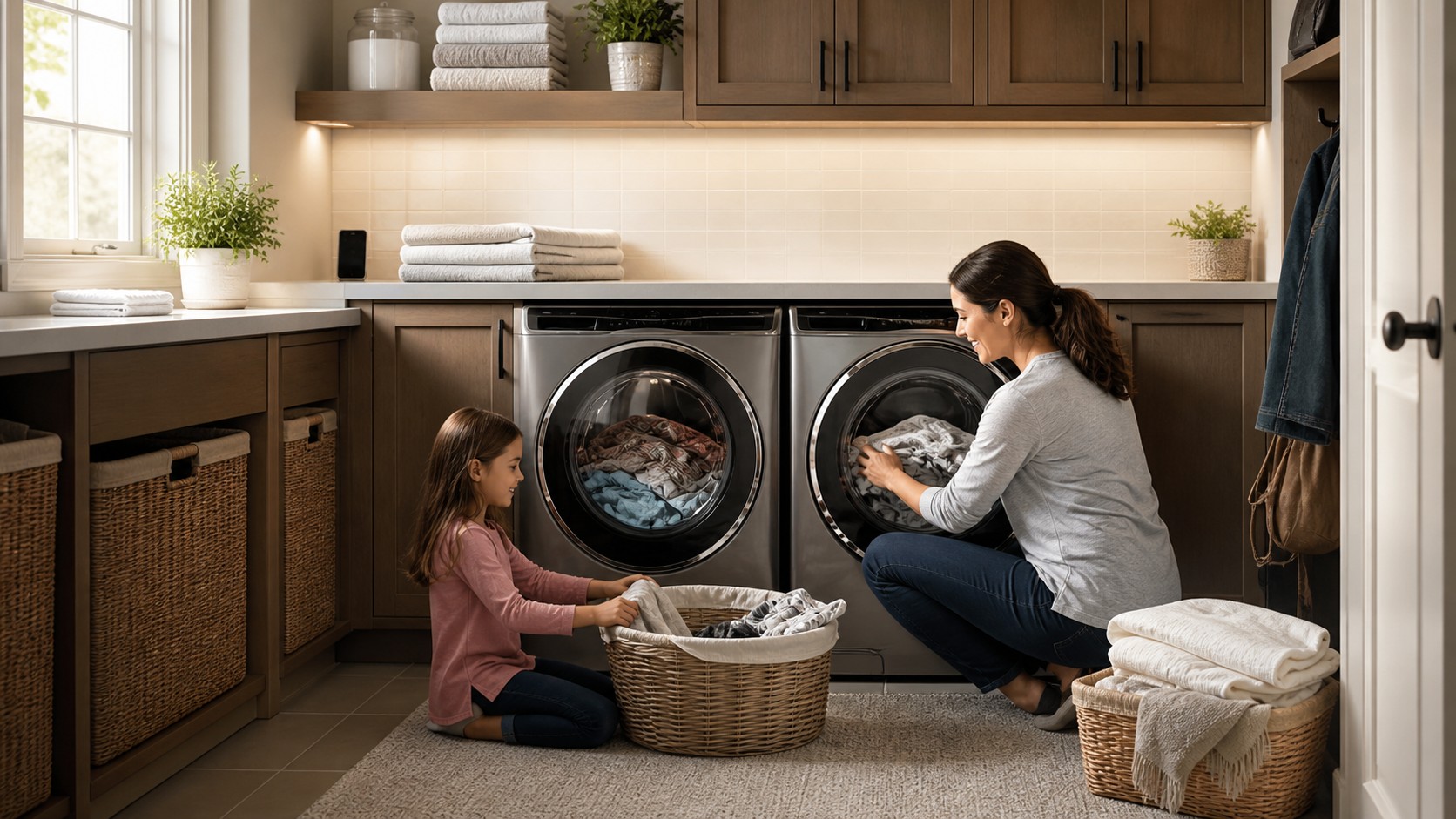
Families usually need smart washers and dryers that are practical before they are clever. Large drums, durable doors, clear controls, and strong everyday cycles matter because the machines may run constantly. Smart alerts help most when they keep towels, sports clothes, bedding, and school laundry from stalling between cycles.
Shared access can be useful in a family home. If more than one person can see when a load is finished, laundry responsibility is easier to distribute. A phone alert will not magically make everyone help, but it removes the mystery of whether a load is ready.
Auto-dosing may also be worth considering. In households where different people add detergent, dosing can vary wildly. A good automatic system can reduce residue, waste, and guesswork. It still needs refilling and cleaning, so it should be chosen for a real habit problem rather than as a novelty.
Dryer features should support speed and fabric care. Moisture sensors, wrinkle alerts, large capacity, and easy lint access are often more valuable than rare specialty cycles. A family dryer that is hard to clean will not stay efficient for long.
The best family smart pair is not necessarily the most technical. It is the pair that handles volume, communicates clearly, and remains simple enough for several people to use without a lecture.
Families should also think about repair tolerance. A pair that runs constantly needs service access, common parts, and controls that are not too delicate. Smart features are welcome, but heavy-use households usually appreciate durability more than novelty.
For Apartments, Condos, and Small Homes
Small homes need smart laundry appliances that respect space. Depth, width, door swing, stacking, and venting can matter more than app features. A compact smart washer or ventless smart dryer may be ideal if it fits the building and matches the user’s load size.
Quiet operation becomes more important when laundry sits near living areas, bedrooms, or shared walls. Smart alerts can reduce door opening and repeated checking, which helps in tight closets. A quiet machine with reliable notifications may feel more luxurious than a louder model with extra cycles.
Wi-Fi strength should be checked in the exact laundry location. Closets, concrete walls, utility rooms, and apartment layouts can weaken the signal. If the connection drops often, the smart features become frustrating.
Ventless drying can pair well with smart monitoring because cycle times may be longer than users expect. A remote status check helps the user see progress without hovering. Still, ventless technology should be chosen for installation fit and energy goals, not just because it appears in a smart product line.
The best small-home pair is measured, quiet, and realistic. It should make compact laundry easier to live with rather than pretending the room is larger than it is.
For many apartment buyers, a simple app with reliable finished-load alerts is enough. Extra connected tools matter less than fit, noise, and dependable cycles.
Small-space buyers should also think about where notifications will be useful. If the machines sit behind closed closet doors, a finished alert can prevent repeated checking. If the machines are only a few steps away, quiet operation and easy controls may matter more than phone features.
Building limits can shape the best choice as much as personal preference. A connected compact pair is only useful if it fits the doorway, meets electrical requirements, manages moisture properly, and can be serviced without upsetting the whole closet design.
For Busy Professionals and Forgetful Laundry Routines
Some homes do not have unusually large laundry needs; they have interrupted laundry needs. Work calls, errands, school pickups, meals, and evening routines can make a load easy to forget. Smart laundry is especially useful in these homes because it nudges the user at the moment action is needed.
Finished-cycle alerts are the main feature to look for. Washer alerts can prevent mildew smells from damp clothes. Dryer alerts can reduce wrinkles. A reminder that repeats after a finished cycle can be more valuable than remote start because it supports the part of laundry people actually miss.
Delay start and remote status can also help when laundry has to fit a schedule. A user might check whether the dryer will finish before leaving the house or whether a washer load is still running before starting dinner. These are small conveniences, but they add up.
The best machines for busy users should remain fast to operate from the panel. Nobody wants to open an app for every ordinary load. The app should step in when the user leaves the room, not slow down the moment they are standing in front of the washer.
A practical smart pair creates fewer abandoned loads. That is the kind of intelligence busy households tend to appreciate most.
Look for reminder settings that match the household’s pace. A single finished chime may be missed, while a second reminder can rescue a load before it sits too long. The best notification pattern is helpful without becoming easy to tune out.
Busy users should also check whether favorite cycles can be saved. A quick, familiar start routine matters because smart laundry should reduce decisions on crowded days rather than adding another screen to manage.
For Energy-Conscious Homes
Energy-conscious buyers should separate smart data from real efficiency. A dashboard can show patterns, but the machine’s design still determines much of the energy and water use. Washer efficiency, spin speed, dryer sensors, heat pump technology, load size, and user habits all matter.
A smart washer can support efficiency by sensing load size, recommending cycles, and reminding users about maintenance. A smart dryer can help by using moisture sensors and showing energy information. These tools are helpful when they change behavior, not when they merely display numbers.
Heat pump smart dryers deserve attention in homes where electricity use and ventless placement matter. They may dry differently from conventional vented machines, so buyers should understand cycle length and maintenance before choosing one.
Smart scheduling may also matter in homes with time-of-use electricity rates. If the app can help shift laundry away from expensive hours, connected features may have a practical payoff. The value depends on local rates and household flexibility.
The best energy-conscious smart pair is efficient first and connected second. Choose strong appliance fundamentals, then use the smart tools to reinforce better habits.
Controls, Apps, and Long-Term Use
The control panel should be judged separately from the app. A good smart washer or dryer should still be easy to use when the phone is not nearby, the Wi-Fi is down, or a guest needs to run a load. Basic cycles should be visible and understandable.
The app should be judged by reliability rather than screenshots. Recent reviews can reveal delayed notifications, sign-in loops, confusing updates, or missing features. Because apps change, recent user experience is more useful than an old product launch description.
Long-term use also includes account management. Buyers should know whether multiple people can use the appliance, whether features require subscriptions, and how to remove the machine from an account later. These details are not exciting, but they affect ownership.
Service support matters too. Connected components, sensors, and apps can create problems that ordinary appliances do not have. A smart pair is more reassuring when the brand has clear support, accessible parts, and technicians familiar with the product.
The best smart laundry appliances age gracefully. They keep doing normal laundry well even if the owner uses only a few connected features.
That kind of graceful aging should influence the purchase. A machine with a strong normal cycle, understandable panel, and reliable finished-load alert may remain satisfying long after more elaborate app features have stopped feeling new.
A Practical Shortlist Method
Start by listing the home’s nonnegotiables: capacity, dryer venting, available depth, stacking needs, noise limits, outlet type, drain access, and budget. Remove any pair that does not fit those basics. This protects the purchase from being led by an app demo.
Next, choose the top three smart features that would actually change the routine. A family might choose shared alerts, auto-dosing, and dryer pairing. A condo owner might choose quiet operation, remote status, and ventless monitoring. A busy professional might choose finished-load reminders and simple favorites.
Then compare the app and controls together. The app should make the machine better from a distance, while the panel should make the machine easy up close. If either side feels weak, the smart experience will be incomplete.
Finally, choose the pair that feels easiest to own. The best smart washer and dryer for a home is the one that fits the space, handles the laundry, communicates usefully, and stays simple enough for ordinary weeks.