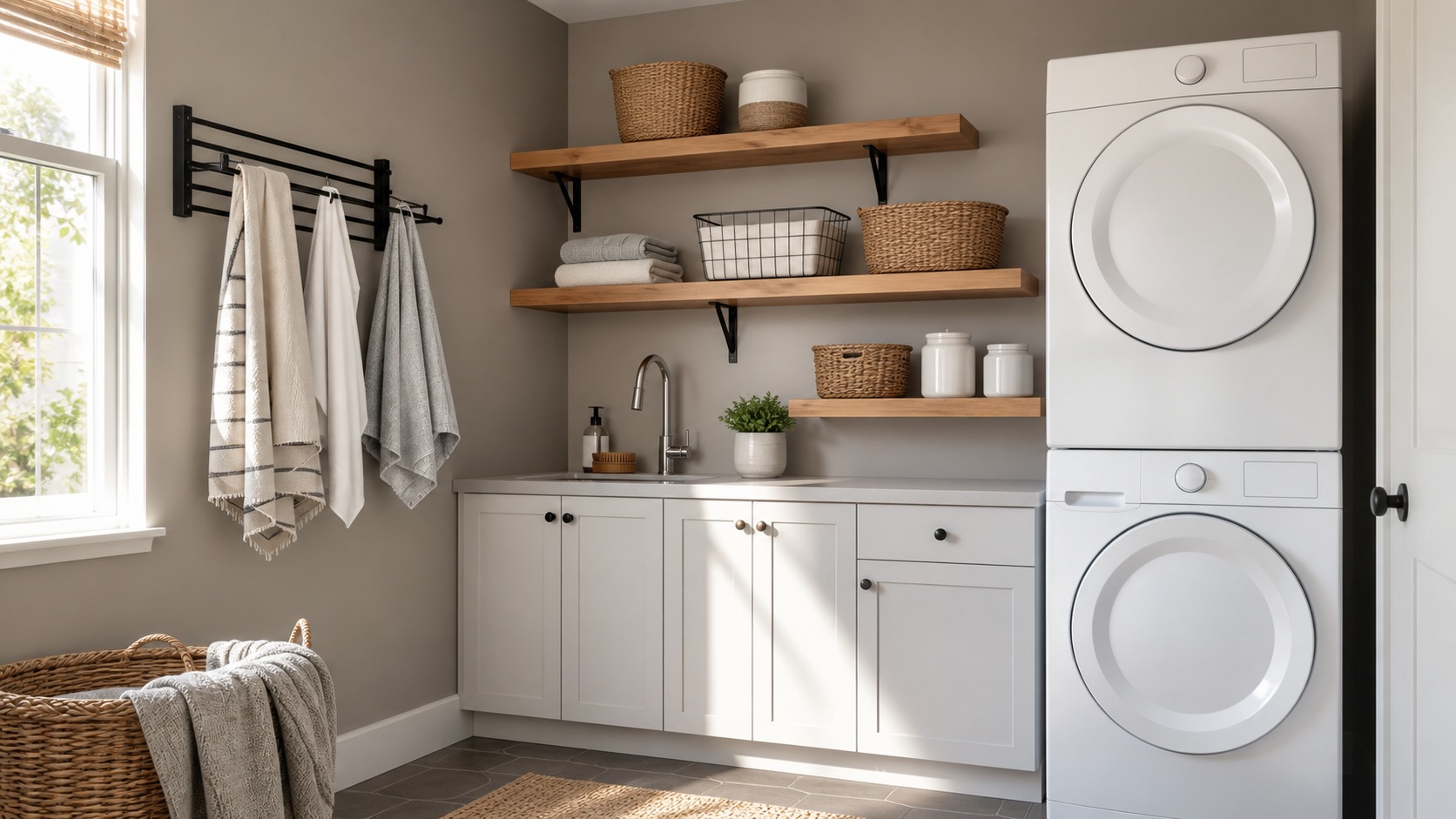
Decor Should Support the Room’s Work, Not Compete With It
A laundry room can feel thoughtful and personal without covering its walls in signs or its counters in accessories. In fact, the most convincing modern decor often begins with restraint: one expressive object, a useful textile, a plant suited to the light, or a hardware finish repeated with care. The room already contains strong visual elements—large appliance doors, cabinetry, baskets, faucets, and folded fabric—so decoration does not need to manufacture interest from scratch. It should soften hard surfaces, establish a point of view, and leave enough physical space for sorting and folding. That requires judging every addition by two standards: what it contributes to the composition and what it demands from the routine. An object that must be moved for every load creates friction; a textured curtain that filters glare or a handsome tray that contains pocket finds earns its place. Style without clutter is less about owning fewer beautiful things than giving a small number of them precise roles.
A: No. Abstract work, landscapes, photography, or sculpture often connect the room more naturally to the home.
A: Ideally none within the required work span; one contained object can sit beyond that protected boundary.
A: Only when light, heat, airflow, and watering access suit the plant and equipment clearances remain protected.
A: Keep original packaging whenever safety directions, dosing, child-resistant closures, or identification are important.
A: Strong proportion, coherent finish, and careful alignment allow rails, faucets, and pulls to contribute visually.
A: A washable, slip-resistant textile may work if it avoids drains, leaks, door swings, and appliance service paths.
A: Assign them narrow functions, preserve removal clearance, and limit decorative pieces to genuine leftover space.
A: Change one useful textile or natural element while keeping permanent materials and the main focal point stable.
A: Combine distinct textures, rounded and linear shapes, and controlled value differences within the neutral range.
A: It has crossed the line when objects block tasks, complicate cleaning, hide utilities, or require extra storage.
Define the Room’s Visual Character in a Few Words
Choose a concise direction before buying accessories: tailored and graphic, warm and organic, quietly coastal, or soft industrial, for example. This is not a theme to illustrate literally. It is a filter for materials, shapes, and color. A tailored room might use dark metal, crisp linen, and one geometric object; an organic room may rely on rounded pottery, wood, and woven fiber.
Keep the direction connected to nearby rooms. Repeating a metal, wood tone, or textile color helps the laundry space feel intentional even when its decor is more playful. The connection can be subtle; exact furniture-style matching is unnecessary.
Protect Empty Counter Space as Part of the Design
Open work surface is visually calming and operationally valuable. Decide how much counter is required for the largest regular folding task, then treat that span as protected space. Decor belongs beyond the boundary, on the wall, or in a contained location that does not migrate.
A single low bowl can hold collar stays, buttons, coins, or other pocket finds without creating several tiny piles. Choose a washable, stable piece that will not tip when the counter vibrates. Once the bowl is full, its contents need resolution; decoration should expose a backlog rather than disguise it.
If a sink shares the counter, keep splash clearance around it. Porous books, framed paper, and untreated wood are poor choices near repeated water use. A durable tray or wall-mounted object can provide character with less maintenance.
Treat Useful Hardware as Decoration
A drying rail, peg strip, faucet, or set of cabinet pulls occupies permanent visual space. Selecting these elements as a coherent family can reduce the need for separate decor. A black rail introduces a clean line; aged brass adds warmth; stainless steel can echo appliance rims without becoming overly coordinated. Grip, corrosion resistance, and load rating still come first. Beautiful hardware that is awkward to use will soon be bypassed by improvised hooks and hangers.
Bring in Textile Softness Carefully
Textiles counter the hardness of machines and counters. A café curtain can filter direct light while preserving privacy, a washable runner can add color underfoot where appropriate, and one hand towel can connect the palette. Choose items that tolerate the room’s moisture and cleaning demands.
Avoid stacking decorative linens where they collect lint or become confused with active laundry. Store spare towels behind a door and display only what is in use. Floor textiles should not interfere with appliance leveling, door swings, floor drains, or the movement of heavy machines.
Select Art for the Environment and Viewing Distance
Art can make a utility room feel connected to the rest of the home, but the subject does not need to reference washing. Abstract shape, landscape, photography, or a small sculptural wall piece can be more enduring than a slogan. Choose scale by the available wall plane rather than filling every narrow gap.
Keep works away from direct splashes and uncontrolled humidity. Use suitable framing and mounting, and make sure glass does not create distracting glare beneath task lighting. A dimensional ceramic or sealed metal piece may suit a durable dry wall when paper-based art would be vulnerable.
Hang art in relation to architecture. Center it on a clear wall segment, align it with a cabinet bank, or let it balance a window. Positioning it arbitrarily above an appliance often makes both the art and the machine feel disconnected.
Use Plants Only Where They Can Thrive
Greenery introduces life and soft geometry, but a laundry room is not automatically a good growing environment. Assess daylight, temperature, drafts, and access for watering. Select a species suited to those conditions and keep it away from dryer heat, chemical splashes, and hanging garments.
One healthy plant is more decorative than several struggling ones. Place it on a ledge or in a corner where foliage will not shed onto folded clothes. If live plants are unsuitable, a branch arrangement can provide temporary texture, though water vessels still need stable placement and routine cleaning.
Let Containers Vary Without Becoming a Collection
Modern rooms do not require rows of identical jars. In fact, decanting detergent can remove safety information and create dosing confusion. Keep chemicals in original containers and conceal them when their packaging disrupts the composition.
Visible containers can hold safer dry items such as clothespins, wool dryer balls, or repair tools. Limit the material palette—perhaps stoneware with woven fiber, or powder-coated metal with wood—and vary shape enough to avoid a catalog-set appearance.
Assign each container a stable location and maximum capacity. A basket that receives unrelated objects becomes decorative clutter with a lid. Its contents should share a next action, not merely fit inside.
Create One Focal Moment
A focal point gives the eye somewhere to settle. It might be a colored cabinet bank, a distinctive wall object, a veined sink backsplash, or a well-proportioned pendant in a room with sufficient clearance. Choose one leader and let other elements support it.
Competing focal points make compact rooms restless. If the backsplash has strong pattern, simplify art and accessories. If a sculptural light dominates, keep the wall treatment quiet. Hierarchy creates style more reliably than accumulating individually appealing features.
Use Repetition to Make Small Details Feel Intentional
Start by identifying the accent already built into the room rather than introducing a new one. The warm edge of a counter, dark appliance glass, or colored floor joint can supply the note repeated by a textile or vessel. This approach makes decor feel discovered within the architecture instead of placed on top of it.
Keep repetition asymmetrical. A small dark faucet does not require identical black objects at every corner; one rail and a narrow frame may be enough to carry the line across the elevation. Stop when the connection becomes legible. Beyond that point, repetition turns into a motif that can make the room feel packaged.
Repeat an accent in two or three places at different scales. A rust textile can relate to a warm stripe in the floor; a rounded wall piece can echo a bowl; a black rail can connect to faucet and hardware. Repetition should be noticeable without looking like a matched package.
Varying texture within one color family creates depth. Smooth pottery, woven linen, and matte paint can share a neutral range while contributing different tactile qualities. This approach is especially effective when the room already contains several appliance finishes.
Style Open Shelves for Removal and Return
Begin with the shelf’s operational contents, then add at most one decorative note where genuine space remains. Leave clearance around baskets so they can be lifted without moving a vase or frame. Heavy objects belong on stable lower levels, not overhead simply because they look balanced in a photograph.
Use groups with a clear silhouette rather than many scattered pieces. A basket, folded textile, and low vessel may read as one useful composition. Five small containers create more edges, more dusting, and more opportunities for objects to drift.
Photograph the styled shelf and then use the room for a week. If objects repeatedly move to complete a task, revise the arrangement. Daily behavior is a more reliable editor than the initial image.
Choose Decor That Is Easy to Clean
Lint settles on textured surfaces and high ledges. Favor objects with broad wipeable forms and avoid fragile arrangements that make routine cleaning tedious. Wash textiles on an appropriate schedule and inspect baskets for snagged fibers or residue.
Wall pieces, planters, and rails need secure mounting. Check hardware periodically where vibration is present. Do not place decor over shutoffs, ventilation openings, or service panels, and keep combustible materials clear of heat sources according to equipment guidance.
Edit Seasonally Instead of Restyling Constantly
A brief seasonal edit can remove objects that have lost purpose, clean neglected surfaces, and adjust one textile or natural element. Avoid storing bins of laundry-room decor that consume the very capacity the room needs. A change in a towel, branch, or small vessel is enough to shift the mood.
Personal style becomes stronger through consistency. Keep the focal point, useful hardware, and foundational materials stable while temporary accents change lightly. This allows the room to evolve without turning each refresh into a new shopping project.
The most stylish laundry rooms remain visibly ready for work. They make room for a basket, a wet garment, and a broad folding task while still offering texture and personality. Protect negative space, choose durable expressive objects, and let functional details carry part of the decorative load. The result will feel collected rather than crowded.
Decorate for the View From Outside the Room
Many laundry rooms are seen from a hallway, kitchen, or mudroom long before someone enters them. Stand at those approach points and identify what dominates the opening. A clear counter edge, one framed wall piece, and a coherent cabinet color may be all the view needs. Move baskets and tools that interrupt the doorway sightline while keeping them convenient inside the room. If the door usually remains open, coordinate its back, casing, and nearby wall rather than treating them as unrelated leftovers.
Finish With a Practical Editing Session
After installation, remove every movable accessory and return only the pieces with a defined contribution. Test a full load of laundry, clean the counter, water the plant, and empty the pocket-find bowl. Note which objects migrate and which ones make those actions easier.
Then check storage consequences. Decorative containers should not force detergent into an unsafe location or send essential tools to another room. Photograph utility access and keep mounting information with household records. A final edit grounded in real use creates a room that looks composed because it operates cleanly, not because activity has been cropped out of the picture. Revisit the room after a month, when novelty has faded and routine has exposed weak choices. Remove anything that still needs explanation, relocation, or special protection. Keep the objects that have become quiet landmarks in the workflow, because useful familiarity is one of the strongest forms of lasting style. The final arrangement should welcome ordinary mess briefly, then make returning to order intuitive and quick for everyone using the room.